

Some home gyms are simple. A few pieces of equipment, a clean layout, good flooring, and enough room to move.
And then there are projects like Charlie’s Showstopper.
This Montana home gym was designed to be more than a workout room. The client wanted a full fitness and wellness experience with strength training, cardio, cold plunge, sauna, outdoor recovery, and views worth designing around.
It had all the ingredients of a dream home gym, but it also came with the same challenge every great project has: the space still had to work.
At Beachside Custom Gyms, this is where our process becomes especially valuable. A beautiful room is only successful if the equipment fits, the circulation makes sense, the training zones are functional, and the details are coordinated before construction gets too far down the road.
Charlie’s Showstopper is a great example of how much thought goes into designing a luxury home gym that actually performs.
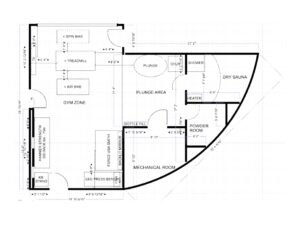
This project came to us through the builder, who needed gym-specific expertise during the planning phase. The client wanted a high-impact space with a serious equipment package, but the room had to accommodate several different uses at once.
The wish list included:
On paper, that sounds incredible.
In reality, fitting all of that into one room requires careful planning. Every door swing, window, walkway, outlet, and piece of equipment matters.
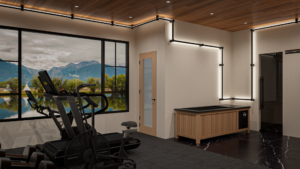
One of the most important decisions in this gym was the cardio orientation.
Traditionally, we might place a treadmill in a different direction based on equipment spacing or wall alignment. But during the design process, we asked a simple question:
What do you want to look at while you’re using the treadmill or bike?
The client wanted to look outside.
That answer changed the layout.
Instead of forcing the cardio equipment into the most obvious position, we rotated the treadmill and bike so the client could enjoy the view while training. The equipment also stayed visually connected to the TV, so the client could watch the news, a game, or entertainment during cardio sessions.
This is one of the biggest mistakes we see in home gym planning. People design around equipment dimensions, but they forget to design around the actual experience of using the space.
A treadmill is not just a rectangle on a floor plan. It is a place where someone may spend 30 to 60 minutes at a time. What they see, how they feel, and how the room supports that routine all matter.
One of the trickiest parts of this room was the number of openings and door swings.
Doors are one of the most overlooked constraints in gym design. Every time a door swings into a room, it reduces usable wall space. That means you cannot simply place storage, equipment, mirrors, racks, or accessories wherever you want.
In Charlie’s gym, the door locations limited where we could place larger equipment and storage. We had to preserve walkways, avoid blocking access points, and make sure the room still felt open instead of crowded.
This is why we never design home gyms by just dropping equipment into a room.
A gym layout has to account for:
When those things are ignored, the room may look fine in a rendering but feel frustrating in real life.
The client wanted serious strength training capability, including cable work, barbell training, and leg press functionality. In a larger room, we might have considered separate pieces of equipment for each training need.
But in this space, a standalone leg press would have created a major problem.
Leg presses are large pieces of equipment. If we placed one in the middle of the room, it would have interrupted the walkway and made the gym feel congested. It also would have competed with the dumbbell area, cardio equipment, and access to the outdoor recovery zone.
Instead, we selected a Force USA C20 system because it allowed us to consolidate multiple functions into one footprint. The machine provided cable training, barbell training, rack functionality, and the ability to add a leg press attachment.
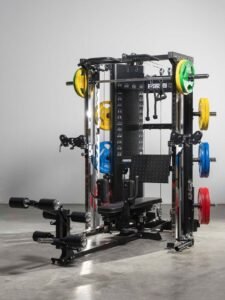
That choice gave the client more training variety without sacrificing the flow of the room.
This is where equipment selection becomes just as important as interior design. The right piece of equipment is not always the most expensive, the most popular, or the most impressive on its own. It is the piece that gives the client the best combination of function, safety, and spatial efficiency.
One of the most important details in this layout was accounting for the real working footprint of the strength equipment.
A squat rack or functional trainer has a published width and depth, but that does not tell the whole story. Once you add a barbell, plates, a bench, and the space required to load and unload weight safely, the usable footprint becomes much larger.
This is a common issue we see in home gym plans. A designer or homeowner may look at the dimensions of a rack and think it fits, but they forget that a seven-foot barbell extends beyond the frame. They also forget that someone needs room to stand beside the bar, load plates, move a bench, and perform exercises safely.
For Charlie’s Showstopper, we planned around the equipment in use, not just the equipment at rest.
That means the layout had to allow for:
This is one of the biggest differences between a room with gym equipment in it and a true performance space.
Because the room had so many competing priorities, storage had to be compact and intentional.
The dumbbells were arranged in a way that kept them accessible without blocking circulation. For kettlebells, we used a vertical storage solution instead of a traditional horizontal rack because the room did not have enough open wall space for a wider setup.
Small decisions like this can make or break a gym.
A three-tier rack may look great in isolation, but if it blocks a walkway or crowds a training zone, it is the wrong choice. In this case, vertical storage helped preserve floor space while still giving the client access to the tools they wanted.
The goal was not just to fit everything in. The goal was to make everything usable.
Treadmill placement deserves special attention in any home gym.
Whenever possible, we like to preserve approximately 72 inches of clear space behind a treadmill. This is a safety standard we try hard not to break because it gives the user room behind the machine if they lose balance or step off unexpectedly.
In some rooms, compromises have to be made, especially when the client has a specific equipment list and the room has fixed architectural constraints. But the 72-inch rule is always part of the conversation.
For this project, we also paid attention to spacing between the cardio pieces. The treadmill and bike needed enough room to feel functional without wasting precious square footage.
This is where luxury gym design is less about filling the room and more about editing. You need enough equipment to meet the client’s goals, but not so much that the room starts working against them.
Charlie’s Showstopper was not just a strength and cardio space. It was a wellness environment.
The project included a cold plunge, sauna, outdoor shower, jacuzzi access, and strong indoor-outdoor connection. These elements changed the way we thought about the room.
A wellness space has to account for transitions. Someone may move from a strength workout to the cold plunge, from the sauna to the outdoor shower, or from cardio to recovery. The layout needs to support that movement without feeling awkward or disconnected.
This is also where early planning becomes critical.
Cold plunges, saunas, and outdoor recovery features often require coordination around:
When these decisions happen too late, they can create unnecessary cost, delays, or design compromises. When they are addressed early, the space feels intentional from the start.
Charlie’s Showstopper is exactly what the name suggests: a high-impact luxury home gym designed to support training, recovery, and daily wellness.
The final plan gives the client a complete performance environment with strength training, cardio, cold plunge, sauna, and outdoor recovery access, all while preserving the view and maintaining functional flow through the room.
It is the kind of space that looks beautiful, but more importantly, it works.
And that is always the goal.
At Beachside Custom Gyms, we believe the best home gyms are not designed by accident. They are planned with the same level of care as a kitchen, primary suite, theater, or outdoor living space. Equipment matters, but so do clearances, circulation, sightlines, infrastructure, and the way the client wants to feel when they use the room.
Charlie’s Showstopper is a perfect example of what happens when performance and design are planned together from the beginning.
Whether you are a homeowner, builder, architect, or designer, the earlier we are brought into the process, the better the final result.
Beachside Custom Gyms helps design, build, procure, and install custom fitness and wellness spaces that are beautiful, functional, and built around the way you actually train.
From home gyms and garage conversions to wellness suites, saunas, cold plunges, and commercial fitness spaces, we help bring the right strategy to the project before costly decisions are made.
Have a fitness or wellness space in the plans? Send it our way. We can review the layout, equipment, spacing, and overall flow before the project gets too far down the road.